


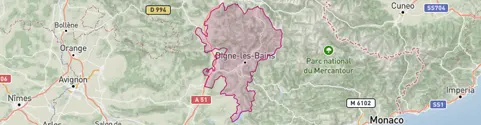


Since first appearing in the region over 400,000 years ago, man has moved from place to place, adapting to the local geography. Despite difficult conditions, they have settled in the area, occupying valleys, hills and plains.
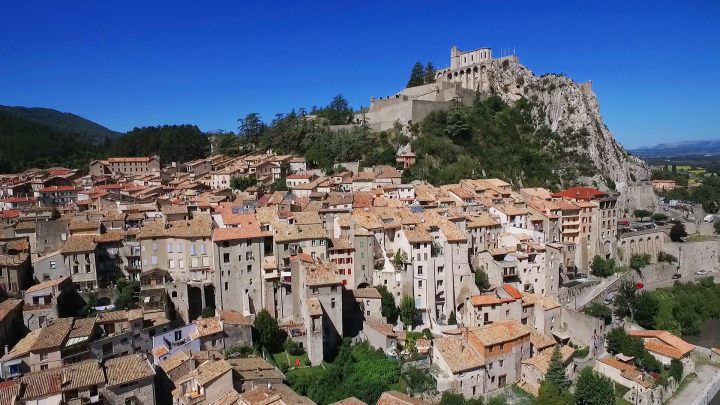
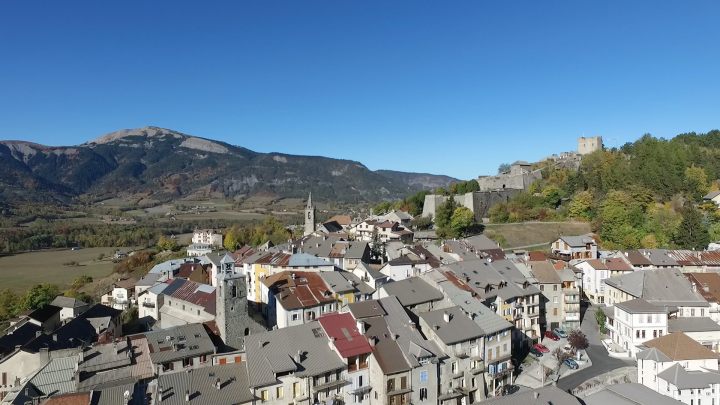
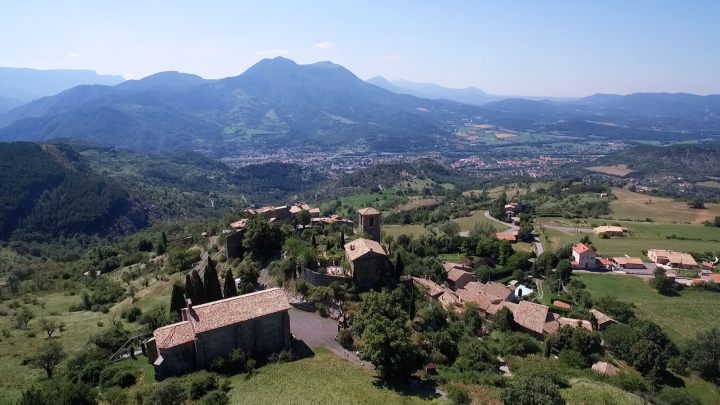
To protect themselves, the inhabitants built villages perched on mountain peaks, like Thoard. Seen from the air, this village has the strange shape of an almond, perfectly fitting the relief on which it sits. Elsewhere, man has also built fortresses with great ingenuity, such as the Citadelle de Sisteron and Fort Vauban de Seyne. These ramparts against the enemy have transformed the outlook of their villages.
Whether perched high up or at the bottom of valleys, the villages are the soul of this region, with their narrow streets, little squares and fountains, as well as their beautiful gates and majestic bell towers.
Estoublon, Courbons and Prads-Haute-Bléone are lively villages that celebrate their patron saint festivals, an ideal time to sample local life and experience the Provencal art of living.
More often than not, this built heritage draws its character from local natural resources, such as plaster (extracted from gypsum). Scattered throughout the area, lime kilns and plaster mills still bear witness to the transformation of these local resources. There’s no doubt that geological history is at the root of this very special soil.

The Écomusée de La Javie is a perfect example of village life at the beginning of the last century. A grocery store, a classroom and a kitchen have all been reconstructed. This evocation of life in the past is made possible by the involvement of local residents, who have not hesitated to dig up all traces of this past life from their attics.
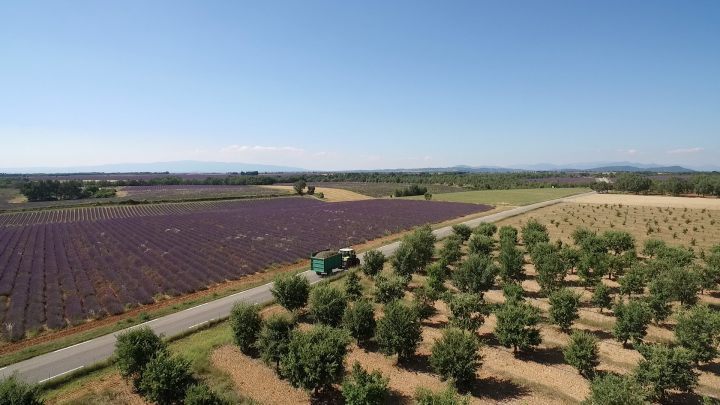
A land of cultivation, but above all, a land of agricultural labor: fruit orchards in the hollows of the Hautes-Terres-de-Provence valley, lavender fields as far as the eye can see on the Valensole plateau, olive groves on the heights of Estoublon and, occasionally, truffle oaks. Through the resources he cultivates, man also maintains the soil. Even the shepherd who takes his sheep to graze on the heights during his annual transhumance.
In the hands of our producers, local produce takes on a special flavor. At Vieux MoulinMarie-France Girard cares for her olive trees all year round. And as soon as the first frost sets in, the harvest begins! The juicy olives are then transformed into a tasty oil. Bleu d’Argenstransforms lavender, a plant with many properties, into essential oils and cosmetics. L’Etoile du Bergerperpetuates the tradition of the candied Sarteau pear: a pear picked in orchards from very old trees, so hard that it cannot be eaten without cooking. Families have learned to cook this fruit to make jam, pear bread, fruit jellies… And every year, the Sarteau pear festival in La Javie is the time to taste all the different ways of cooking it.

This nourishing land also provides other raw materials for craftsmen. In Moustiers-Sainte-Marie, for example, a village nestled against a mountain reminiscent of Tuscany, you can discover the talent of master earthenware makers like the Bondil family. Earthenware, whose original material is none other than clay, is a delicate craft requiring patience and precision. In the hands of the santonnier, the clay is kneaded to form the santons de Provence. With Christmas just around the corner, come and discover these countless figurines, characters from local life past and present, at the Foire aux Santons de Champtercier.

Numerous personalities have lived in the UNESCO Geopark area, and we have inherited a lifetime’s work.
Among them are Alexandra David-Neel (1868-1969), orientalist, explorer and Buddhist. She was the first European woman to visit Lhasa in Tibet in 1924. She spent the rest of her life in Digne-les-Bains. You can visit her house, which features countless period photographs tracing her exceptional career.
Maria Borrély (1890-1963), a novelist involved in the French Resistance, is the author of “Le dernier feu” (The Last Fire), published in 1931. This novel tells the story of the disappearance of a village on the Valensole plateau, whose inhabitants, victims of nature’s raging elements, are forced to leave their land and descend into the valley. Jean Proal (1904-1969), also a writer from the commune of Seyne-les-Alpes, wrote his first novel at the age of 28: “Tempête de printemps” (Spring Storm), published in 1932. The story takes place near Digne-les-Bains: 18-year-old Sylvain decides to leave his mountain hamlet and the obligations that go with it, and take over the family farm.
Through mountains and forests, he set out to follow the seasons and the harshness of nature. Some of you may know the poet and writer from Sion, Paul Arène (1843-1896), who published his masterpiece at the age of 25, “Jean-des-Figues”: the story of a young Provençal leaving his homeland for the capital, Paris.
Sébastien Le Prestre, Marquis de Vauban (1815-1893), engineer and military architect, was appointed Marshal of France by Louis XIV. He had an incredible career, and was involved in the design of the Seyne fort and the Sisteron Citadel. As for Louis Gabriel Prosper Demontzey (1831-1898), he was a French water and forestry engineer who led an exceptional reforestation plan for the mountains of the Alpes de Haute-Provence in the 19th century.