


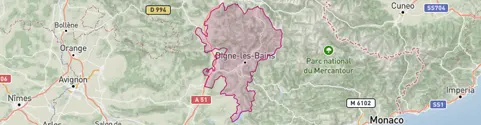


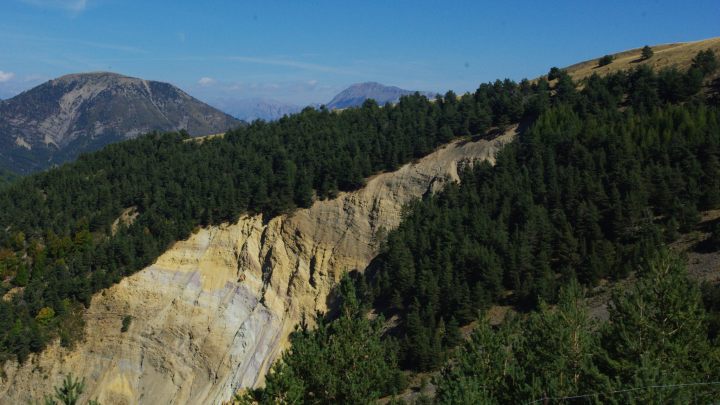
The UNESCO Geopark of Haute-Provence stretches across the southern Alps from Lac de Sainte-Croix on the Verdon to Lac de Serre-Ponçon on the Durance. The Tête de l’Estrop is just 40 metres short of the “3000”, yet for hundreds of millions of years this land was under the sea. It was the collision of the African plate with the European that gave rise to the Alps, where we are today.
The extraordinary history of the Haute-Provence Geopark began 300 million years ago with tropical forests of tree ferns.
Several episodes follow in quick succession:
- Triassic lagoons in an arid climate.
- The Jurassic and Cretaceous seas, which gradually deepen in a wide variety of environments, are teeming with life, including ammonites, belemnites, ichthyosaurs and fish. Much of the sediment that formed the rocks of our mountains was deposited here. The basins gradually filled in.
- The Tertiary Era (or Cenozoic) is the period when the Alpine mountains were formed. The sea occupies different areas before withdrawing for good, and the sediments deposited there are quite different from the previous ones. Sediments are also deposited in lakes and rivers, which play an important role in the landscape.
- In the Quaternary, the Haute-Provence Geopark emerged and glaciers descended from the Alps into our valleys. Since their retreat 15,000 years ago, man has shaped and modified this territory.
The Carboniferous, a nod to the primary era
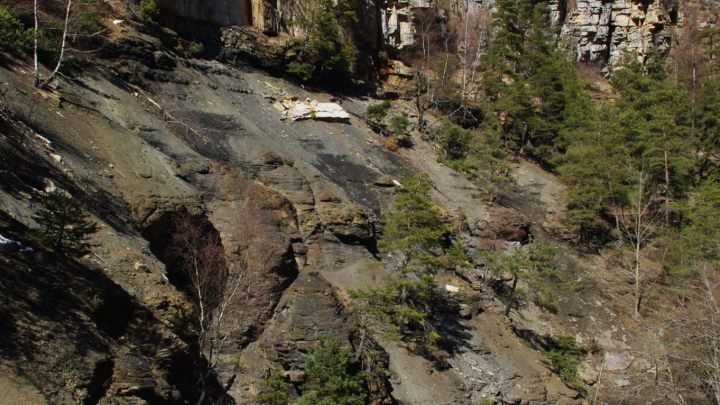
The Carboniferous soils were deposited around 300 million years ago, at a time when our region was covered with forests of tree ferns, giant horsetails and the ancestors of today’s conifers. They lived in a warm, humid equatorial climate.
Rock analysis shows a marshy floodplain environment. Plant debris was rapidly and regularly buried in the sediments, leading to the formation of coal beds.
On the other hand, there is no trace of deposits from the next period, the Permian (-298,-252ma), which marks the end of the Primary Era. It is likely that our region was then a relief (within the Hercynian mountain range) subject to erosion, where there were no deposits (much like today).
In addition to the greatest mass extinction in the living world, the end of the Primary Era was also marked by climate change and the erosion of the Hercynian mountain chain.
Triassic gypsum age
In the Triassic, the single super-continent known as Pangea gradually fragmented into two groups separated by marine space: the Tethys Ocean settled between Laurasia to the north and Gondwana to the south. Our region lies on the southern margin of Laurasia.
Lower Triassic soils are rather rare in our territory, especially the quartzites of the Clue de Verdaches, which represent ancient quartz sands and gravels carried by rivers.
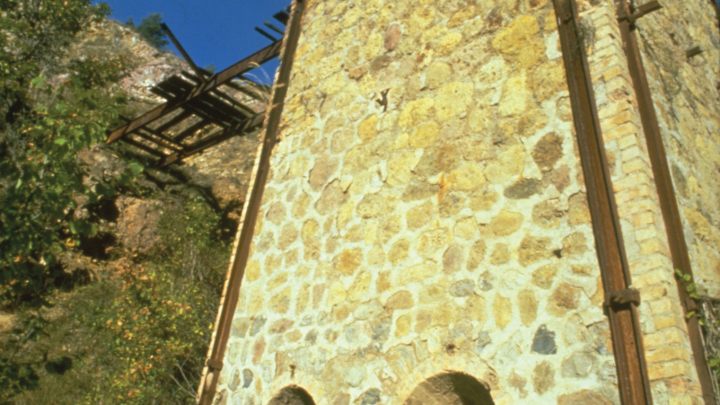
Subsequently, the most abundant and spectacular rocks are brightly colored argillites, often associated with large deposits of gypsum.gypsum was deposited in an environment of lagoons under a hot, arid climate, and is an evaporite like the salt and anhydrite that often accompany it.gypsum plays an important role in structuring the Alpine chain, facilitating the movement of large panels of rock thanks to its great plasticity. Gypsum is also a traditional raw material that has contributed to the originality of old buildings. In the past, every village that was able to do so would bake its own plaster for local use.
Lower Jurassic (Lias)
The beginnings of the sea
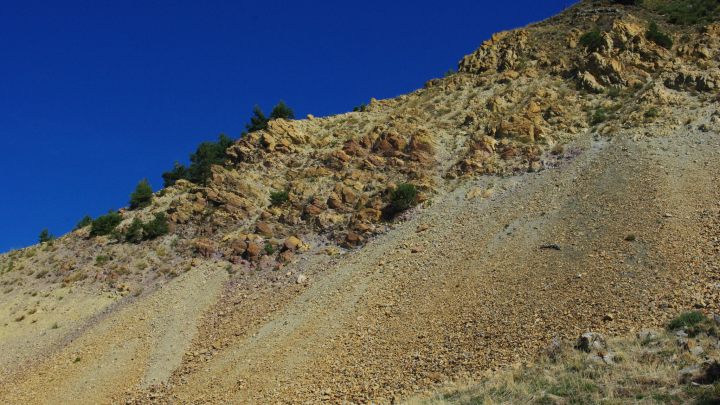
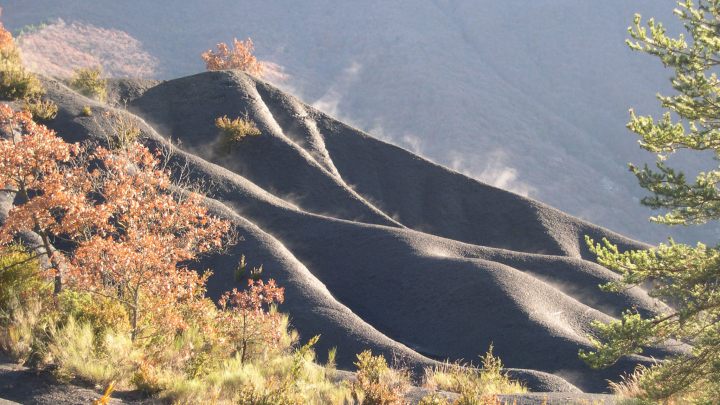
In the Liassic period, oceanic expansion deepened and widened the marine space; our region is clearly underwater. The submarine topography is unevenly shaped by faults that offset large panels of the earth’s crust. The sediments deposited are modulated by this topography. They become limestone, marl or marl-limestone, depending on depth, agitation and distance from shore.
On our territory, there are major differences between the Provençal south, where deposits are more coastal and thinner, and the Dauphinois north, where deposits are more pelagic (turned towards the open sea) and thicker.
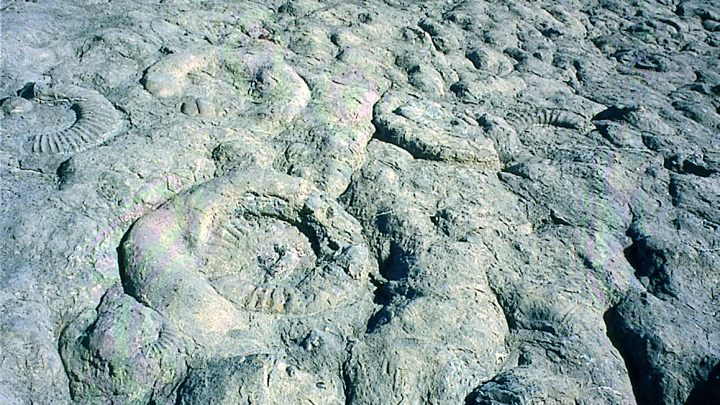
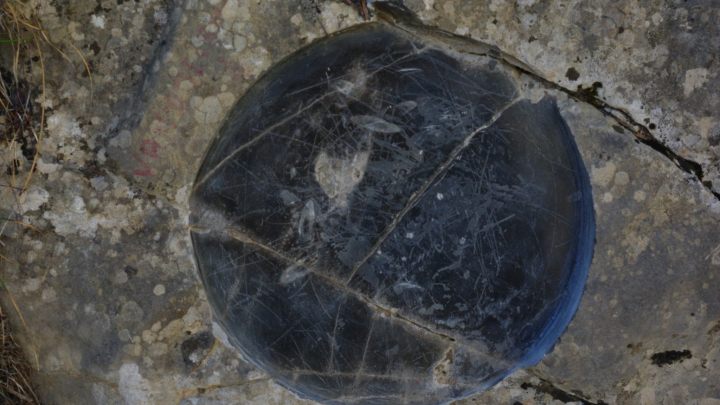
The sea is teeming with life and fossils are abundant. Some of the Geopark’s most emblematic sites date from this period: the ammonite slab, the ichthyosaurusat La Robine, the Astoin turnstiles, etc.