




From inventorying geological sites to creating a reserve
Back in 1978. The town of Digne wanted to revive and diversify its tourist industry. It offered a study grant to the Université de Provence in Marseille to inventory the geological riches of its territory. Guy Martini, Nadine Gomez (formerly curator of the Musée Gassendi) and other students took part in five fossil site excavations. They soon realized that the sites were in poor condition and threatened by damage and looting.
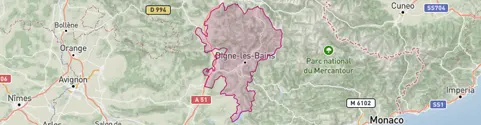
From this awareness came the desire to set up a protective structure. In 1984, the Haute-Provence National Geological Nature Reserve was created by decree. With a surface area of over 2000 km² and 18 classified sites, it is the largest in Europe.

The 1st international symposium on geological heritage in Digne-les-Bains
In 1991, the Geological Reserve organized the 1st International Symposium on the Protection of Geological Heritage in Digne-les-Bains, under the auspices of UNESCO.
Nearly 200 participants from some 30 countries meet for four days. They pool their experience and their approach to heritage protection. At the end of their work, they adopted the International Declaration of the Rights of the Memory of the Earth known throughout the world as the “Digne Declaration”. This founding text, recognizing geological heritage as a common heritage to be preserved on a global scale, laid the foundations for what would a few years later become the UNESCO World Geopark label. The “Digne Declaration” is cited in every corner of the globe, and serves as the basis for policies to protect and promote geological heritage in the long term.
THE INTERNATIONAL DECLARATION OF THE RIGHTS OF THE MEMORY OF THE EARTH
- Every human being is recognized as unique. Isn’t it time to affirm the presence and uniqueness of the Earth?
- The Earth carries us. We are linked to the Earth, and the Earth is the link between each of us.
- The four-and-a-half-billion-year-old Earth is the cradle of Life, of the renewal and metamorphosis of living organisms. Its long evolution and slow maturation have shaped the environment in which we live.
- Our history and the history of the Earth are intimately linked. Its origins are our origins. Its history is our history, and its future will be our future.
- The face of the Earth, its shape, is Man’s environment. This environment is different from tomorrow’s. Man is one of the Earth’s moments; he is not an end in itself, he is a passage.
- Just as an old tree preserves the memory of its growth and life in its trunk, the Earth preserves the memory of the past… a memory inscribed in the depths and on the surface, in rocks, fossils and landscapes, a memory that can be read and translated.
- Today, people know how to protect their memory: their cultural heritage. We have barely begun to protect our immediate environment, our natural heritage.
The Earth’s past is no less important than man’s past. It’s time for mankind to learn to protect and, in so doing, to learn about the Earth’s past, the memory that came before mankind’s memory, which is a new heritage: geological heritage. - The geological heritage is the common property of Man and the Earth. Every human being and every government is merely the custodian of this heritage. Everyone must understand that the slightest depredation is a mutilation, a destruction, an irremediable loss. All development work must take account of the value and uniqueness of this heritage.
- The participants in the 1st International Symposium on the Protection of Geological Heritage, made up of over a hundred specialists from thirty different nations, are urging all national and international authorities to consider and protect geological heritage through all legal, financial and organizational measures.
Signed on June 13, 1991, in Digne, France.
Transdisciplinarity: a broader vision of geological heritage
Over the years, the original idea of forging links between science, art, history and culture has grown and developed, so that geology is no longer the preserve of the few. Far from being a science closed in on itself. Geology explains settlements, the layout of villages, the organization of economic activity and the vagaries of the history of mankind and the Earth. It helps us to understand today’s territories and landscapes, and is of interest to all those who question time, be they artists, thinkers, cultural players, residents or tourists.


Contemporary art takes over the region
This broader vision of geological heritage opened the door to many enriching encounters: philosophers, writers, dancers… It also attracted internationally renowned contemporary artists such as Andy Goldsworthy, who gradually installed a collection of works of art in the heart of nature. This transdisciplinary approach was highly original for its time.
Local residents get involved in the Geopark project
The aim is also to involve local residents in this approach: people who love their region, its landscapes, its culture and its values. A network of local “geopartners” is being formed, including mountain guides, craftsmen, producers, accommodation providers, cultural sites…
Other geoparks are being created around the world. History continues to be made…
