




For thousands of years, the estate's spring has deposited the tufa on which the buildings are built. It flows continuously and irrigates the estate, which is made up of terraces that tame the slope and have supported a variety of crops over the centuries. The Grande Cascade, majestic and refreshing, comes from this spring.

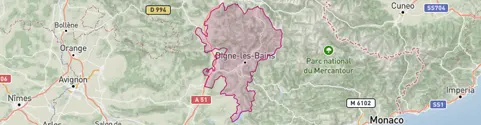
The Saint-Benoît estate is located in Robeyer, in the Courbons area.
The ramparts delimiting the building date back to the 13th century.
Two twin caves carved into the cliff have been discovered. In each cell, a stone bench was cut into the rock. An underground passage could have linked them to the priory. These caves probably served as dwellings for the monks (troglodyte dwellings). Religious origins are therefore probable, but have yet to be confirmed.

Saint Benoît is covered by vineyards owned by several Dignois landowners. Other plots of arable land, heather and meadows make up the estate.
In 1556, N. Reynaud commissioned the construction of a bastide 5 canes long by 2 wide next to his vineyard. A second adjoining property belonging to Jehan Michel, holamier (sickle merchant), is also on the estate. Saint-Benoît was passed on to the heirs of each family over many years.
In 1556, N. Reynaud commissioned the construction of a bastide 5 canes long by 2 wide next to his vineyard. A second adjoining property belonging to Jehan Michel, holamier (sickle merchant), is also on the estate. Saint-Benoît was passed on to the heirs of each family over many years.

In 1583, the community of Digne signed an agreement with Michel Geoffret (husband of one of the estate's heiresses) to allow the extraction of tuff from the tuvières valley. The Saint Benoît district was thus used as a quarry for building stone, a solid, light rock well suited to the construction or restoration of buildings.
In the early 18th century, the Saint-Benoît district was once again used as a quarry. The tuff was used to repair the Grand Pont de Digne and to embellish the château of Seigneur de Gaubert, Marquis de Courbons, with a tuff cornice.
In the 19th century, the quarry was still in operation. In 1848, the material was used to build the vaults of Saint Jérôme Cathedral when it was enlarged.
In the early 18th century, the Saint-Benoît district was once again used as a quarry. The tuff was used to repair the Grand Pont de Digne and to embellish the château of Seigneur de Gaubert, Marquis de Courbons, with a tuff cornice.
In the 19th century, the quarry was still in operation. In 1848, the material was used to build the vaults of Saint Jérôme Cathedral when it was enlarged.

As a result of inheritances and new acquisitions, two families, then just one, owned the Saint-Benoît estate: primarily Gaspard Ailhaud and his descendants (and Monet Martel).
For nearly three centuries, the Ailhaud family ran the estate, adding a new economic activity: the manufacture of woollen cloth. This included finishing, fulling and dyeing. The fabrics are sold in Digne. A fulling mill ("paroir à drap", operated by a master parendurier) was set up in Saint-Benoît thanks to the presence of an abundant spring. The water was fed into a basin, then fell into a waterfall, enabling the mill to operate. The mill was located below the bastide, against a rock formed of limestone concretions (tuff).
In this type of mill, a vertical waterwheel drives a camshaft that lifts hammers designed to knead and stir pieces of cloth placed in vats. This operation, which uses an alkaline or soapy solution, tightens the fibers and gives the wool cloth its strength. The craftsman then proceeds with the other finishing operations on the fabric: raising, shearing, dyeing, washing, drying, hot-pressing... before being able to market it in the Digne boutique. Dyeing after the fulling operation was carried out in another building, which no longer exists and which was located to the left of the entrance to today's museum. The two buildings of St Benoît were connected by an underground gallery ending in a vault bearing the inscription A.1697. Access to the fuller's workshop was therefore direct from the cellar of the house, without having to go outside.
Access to the estate is via the chemin vicinal de Digne-les-Bains à la Robine (commonly known as the sentier de Caguerenard).
Agricultural activities have never been abandoned in St Benoît. Depending on the period, inheritance or sale documents trace: the bastide, the farmyard, meadows and gardens, chenevière and terre gaste, or wasteland, heather and buissières, pathègue... waterable and non-waterable land, vines, hermas, dovecote, wood and rubble, in addition to the linen room in the property's second building. Year after year, the property continued to expand through successive purchases of land and equipment. In the 18th century, the two fulling mills were accompanied by a complete dye house (including a dye factory) and warehouses for storing fabrics. Ravin de la Meynière, adjacent to St Benoît, became part of the family estate in 1807, along with a store in Digne and two cellars in town. The estate was valued at 28,000 francs, including 24,000 in St Benoît in 1838.
For nearly three centuries, the Ailhaud family ran the estate, adding a new economic activity: the manufacture of woollen cloth. This included finishing, fulling and dyeing. The fabrics are sold in Digne. A fulling mill ("paroir à drap", operated by a master parendurier) was set up in Saint-Benoît thanks to the presence of an abundant spring. The water was fed into a basin, then fell into a waterfall, enabling the mill to operate. The mill was located below the bastide, against a rock formed of limestone concretions (tuff).
In this type of mill, a vertical waterwheel drives a camshaft that lifts hammers designed to knead and stir pieces of cloth placed in vats. This operation, which uses an alkaline or soapy solution, tightens the fibers and gives the wool cloth its strength. The craftsman then proceeds with the other finishing operations on the fabric: raising, shearing, dyeing, washing, drying, hot-pressing... before being able to market it in the Digne boutique. Dyeing after the fulling operation was carried out in another building, which no longer exists and which was located to the left of the entrance to today's museum. The two buildings of St Benoît were connected by an underground gallery ending in a vault bearing the inscription A.1697. Access to the fuller's workshop was therefore direct from the cellar of the house, without having to go outside.
Access to the estate is via the chemin vicinal de Digne-les-Bains à la Robine (commonly known as the sentier de Caguerenard).
Agricultural activities have never been abandoned in St Benoît. Depending on the period, inheritance or sale documents trace: the bastide, the farmyard, meadows and gardens, chenevière and terre gaste, or wasteland, heather and buissières, pathègue... waterable and non-waterable land, vines, hermas, dovecote, wood and rubble, in addition to the linen room in the property's second building. Year after year, the property continued to expand through successive purchases of land and equipment. In the 18th century, the two fulling mills were accompanied by a complete dye house (including a dye factory) and warehouses for storing fabrics. Ravin de la Meynière, adjacent to St Benoît, became part of the family estate in 1807, along with a store in Digne and two cellars in town. The estate was valued at 28,000 francs, including 24,000 in St Benoît in 1838.

The spring water is an asset to the estate. When it's not being used for the fulling mill, it's diverted into another basin where it cascades down. An irrigation system waters the meadows and feeds another district below, La Meynière. The water used by the mill is also recovered by a tailrace.
In 1941, Digne town council considered buying the spring on the property to supply the town. Analyses showed that the quality of the water was satisfactory, "although it contained a lot of lime sulfate". At the time, the flow rate was estimated at 86.4 liters per inhabitant per day. Today, an average of 13 liters of water per second flows from the spring, equivalent to over 400 million liters per year, at a year-round temperature of between 11 and 13°C.
In 1941, Digne town council considered buying the spring on the property to supply the town. Analyses showed that the quality of the water was satisfactory, "although it contained a lot of lime sulfate". At the time, the flow rate was estimated at 86.4 liters per inhabitant per day. Today, an average of 13 liters of water per second flows from the spring, equivalent to over 400 million liters per year, at a year-round temperature of between 11 and 13°C.

Around 1840, the Ailhaud family abandoned woollen cloth production in Saint-Benoît because of competing mills developing in Digne ("hammer mills were replaced by cylinder mills"). In 1857, the mill was converted into a farm building, before being demolished. The estate reverted to rural use.
Today, the site of the former mill is home to the CAIRN artists' residence.
Saint-Benoît in the 19thcentury.
Watercolor by Hippolyte Ailhaud (Musée Gassendi Digne les Bains) Bastide surmounted by its dovecote, adjoining dye factory and the fuller's workshop below.
Watercolor by Hippolyte Ailhaud (Musée Gassendi Digne les Bains) Bastide surmounted by its dovecote, adjoining dye factory and the fuller's workshop below.

Following the bankruptcy of the Ailhaud company (1873), the property was sold to Dr. Frison in 1876: 49ha, 11a, 52ca, for use as a pleasure park. He improved the estate, built a carriage road from the Pont des Arches bridge, restored the main building and created a new pond (the current one).
The La Meynière parcel was separated from the rest of the property through inheritance and is therefore not part of Dr. Frison's estate, which is subject to a 5-day-a-week water supply right: expert report drawn up in 1896. Dr. Frison's nephew inherited Saint-Benoît, and the Pellegrin family moved in in 1930 and expanded the estate.
In 1941, Digne town council considered buying the "Pellegrin spring" to supply the town. In 1942, the estate and spring were appraised to compensate the owners. The house has 18 rooms and overlooks terraced farmland. The value of the property comes from the judicious use of water: a waterfall embellishing the cool driveways, and a lovely pool near the house, which is equipped with electricity and telephone. The Town Hall's proposal was rejected by the two owners (de St Benoit et de la Meynière).
From 1946 to 1948, the property housed an apprenticeship center, pending the construction of a new, larger facility.
Survey plan 1896
The La Meynière parcel was separated from the rest of the property through inheritance and is therefore not part of Dr. Frison's estate, which is subject to a 5-day-a-week water supply right: expert report drawn up in 1896. Dr. Frison's nephew inherited Saint-Benoît, and the Pellegrin family moved in in 1930 and expanded the estate.
In 1941, Digne town council considered buying the "Pellegrin spring" to supply the town. In 1942, the estate and spring were appraised to compensate the owners. The house has 18 rooms and overlooks terraced farmland. The value of the property comes from the judicious use of water: a waterfall embellishing the cool driveways, and a lovely pool near the house, which is equipped with electricity and telephone. The Town Hall's proposal was rejected by the two owners (de St Benoit et de la Meynière).
From 1946 to 1948, the property housed an apprenticeship center, pending the construction of a new, larger facility.
Survey plan 1896

On December 21, 1949, the Pellegrin heirs sold the property to the city of Aix, which wished to create a vacation center there. Renovation work was organized: modification of the main building, enlargement of the refectory, demolition of the forge, installation of sanitary facilities and boiler room, and conversion of the attic into a dormitory. Outside, work involved raising the parapet wall and installing a water supply to the old farmhouse, where washbasins would be installed for the boys' dormitory. Next, a new building was erected at the entrance to the property, known as "le camp", to house the boys in better-equipped quarters. The old "château" was reserved for the girls and the kindergarten. The camp operated in July and August, and 150 children between the ages of 5 and 14 attended until 1970.
On April 2, 1971, a commission examined the conformity of the facilities and verified the safety of the site. Serious risks of landslides were reported. The Aix town council abandoned the premises. The center remained virtually abandoned for several years, inhabited only by a janitor. While the site was closed, trees were replanted on 20 hectares and 86 ares of land, subject to the forestry regime, to combat gullying.
On April 2, 1971, a commission examined the conformity of the facilities and verified the safety of the site. Serious risks of landslides were reported. The Aix town council abandoned the premises. The center remained virtually abandoned for several years, inhabited only by a janitor. While the site was closed, trees were replanted on 20 hectares and 86 ares of land, subject to the forestry regime, to combat gullying.

On September 17, 1979, the town of Digne acquired the 27 ha, 35 a 32 ca estate. It planned to create a center for geological studies. The project was carried out from 1981 to 1984, with demolition and reinforcement work to eliminate the risk of landslides.
During this period, a summer camp was set up for children from Digne during the summer vacations (1980-1985).
During this period, a summer camp was set up for children from Digne during the summer vacations (1980-1985).

The Haute-Provence Geological Nature Reserve, newly created by decree on October 31, 1984, officially takes up residence on the premises of the Saint-Benoît estate.
Exhibitions and events follow one another at the Musée de Géologie, dedicated to the protection and promotion of our geological heritage, much to the delight of visitors and schoolchildren alike.
Exhibitions and events follow one another at the Musée de Géologie, dedicated to the protection and promotion of our geological heritage, much to the delight of visitors and schoolchildren alike.

From 2014, when the Geological Reserve was taken over by the Conseil Départemental 04, the Musée Promenade officially became the headquarters of the Haute-Provence UNESCO World Geopark. It's an interpretation space that showcases the territory and its various heritages. Exhibition rooms give visitors a better understanding of the concept and the reasons behind this prestigious UNESCO label: fossils illustrating the rich marine biodiversity of the secondary era, butterflies in the wild illustrating today's rich biodiversity, immersive exhibition in the Geopark landscapes... In addition to the streams and petrifying waterfalls that refresh the park under the forest canopy, the Parc St-Benoît is enhanced by numerous artistic installations, paths and landscaped gardens: Japanese garden and butterfly garden, among which visitors are invited to wander and marvel.