


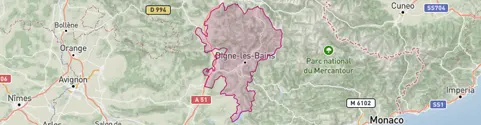


In 1991, the Haute-Provence Geological Reserve organized the first International Symposium for the Protection of Geological Heritage, under the auspices of UNESCO.
Nearly 200 participants from 30 countries adopt the International Declaration of the Rights of the Memory of the Earth, also known as the “Digne Declaration“. This text highlights mankind’s intimate relationship with the Earth. It defines, for the first time, a new heritage for mankind: geological heritage. The Declaration has been translated into some 50 languages, and is still today the cornerstone of all international policies concerning geology.
Without realizing it at the time, this Declaration heralded the Geopark creation process.
Play Video
THE INTERNATIONAL DECLARATION
OF THE RIGHTS OF THE MEMORY OF THE EARTH
OF THE RIGHTS OF THE MEMORY OF THE EARTH
- Every human being is recognized as unique. Isn’t it time to affirm the presence and uniqueness of the Earth?
- The Earth carries us. We are linked to the Earth and the Earth is the link between each of us.
- The four-and-a-half-billion-year-old Earth is the cradle of Life, of the renewal and metamorphosis of living organisms. Its long evolution and slow maturation have shaped the environment in which we live.
- Our history and the history of the Earth are intimately linked. Its origins are our origins. Its history is our history, and its future will be our future.
- The face of the Earth, its shape, is Man’s environment. This environment is different from tomorrow’s. Man is one of the Earth’s moments; he is not an end in itself, he is a passage.
- Just as an old tree preserves the memory of its growth and life in its trunk, the Earth preserves the memory of the past… a memory inscribed in the depths and on the surface, in rocks, fossils and landscapes, a memory that can be read and translated.
- Today, people know how to protect their memory: their cultural heritage. We have barely begun to protect our immediate environment, our natural heritage.
The Earth’s past is no less important than man’s past. It’s time for mankind to learn to protect and, in so doing, to learn about the Earth’s past, the memory that came before mankind’s memory, which is a new heritage: geological heritage. - The geological heritage is the common property of Man and Earth. Every human being and every government is merely the custodian of this heritage. Everyone must understand that the slightest depredation is a mutilation, a destruction, an irremediable loss. All development work must take into account the value and uniqueness of this heritage.
- The participants in the 1st International Symposium on the Protection of Geological Heritage, made up of over a hundred specialists from thirty different nations, are urging all national and international authorities to consider and protect geological heritage through all legal, financial and organizational measures.
Signed on June 13, 1991, in Digne, France.